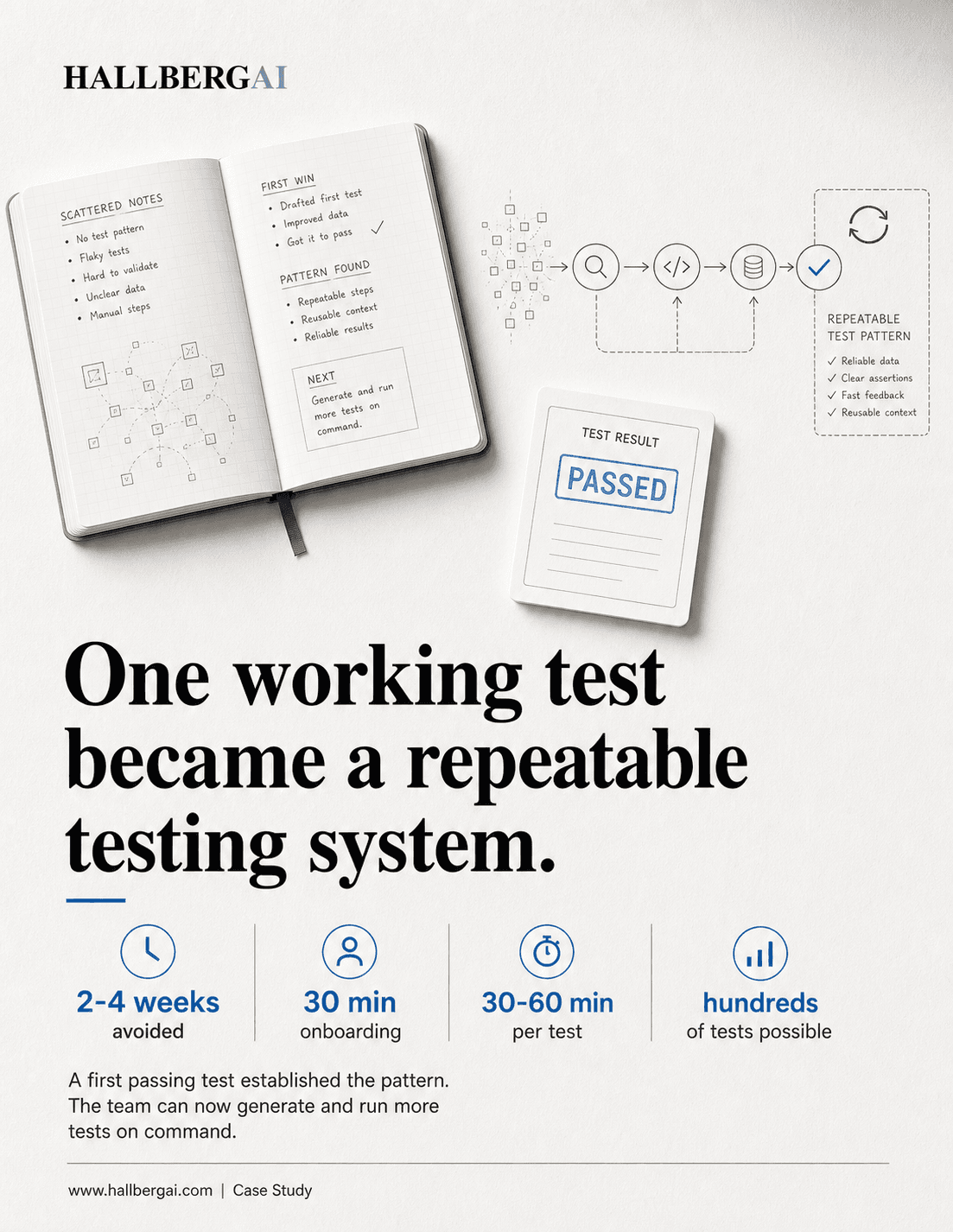
2-4 weeks
avoided in setup and discovery
Focused context and a defined testing workflow compressed the usual ramp-up.
Government engineering case study
AI adoption is not tool access. It is repeatable work.
A government engineering team used AI to establish a first passing unit test, then turned that work into a reusable testing workflow. The important outcome was not a single impressive output. It was a pattern another engineer could pick up, repeat, and scale.
2-4 weeks
Focused context and a defined testing workflow compressed the usual ramp-up.
30 min
Another engineer could learn the process quickly instead of rediscovering the setup.
30-60 min
After setup, the team could generate and review tests in a repeatable cycle.
100s
The process created a practical path for expanding test coverage.
Full write-up
The public page shows the story visually. The full write-up explains the environment, task, AI-assisted testing workflow, results, what did not work well, and the team-level implications.
It is anonymized for public use and written for leaders evaluating where AI can become a repeatable engineering workflow rather than a one-off demo.
Visual summary
The four-page visual PDF is still available as a lightweight follow-up asset.
Download the visual summaryFull case study PDF
Enter your email and the page will unlock the full PDF immediately. Use it to evaluate what a repeatable AI testing workflow looks like before starting a broader pilot.
Problem
The team did not need a broad AI demo. It needed a practical way to generate trustworthy tests inside an existing engineering environment. That meant working through context, assertions, data, review expectations, and team handoff instead of stopping at a promising first draft.
Step 1
Pick one testable behavior with enough system context to verify quality.
Step 2
Define the testing standard, data expectations, and review criteria for that target.
Step 3
Generate, run, and refine the first test until it meets the team's standards.
Step 4
Capture the process so another engineer can use it without rediscovering the setup.
The workflow
The team did not stop at a generated test. The work became useful when the steps around the test became visible, teachable, and repeatable enough for another engineer to use.
The first passing test gave the team a concrete baseline: what context the model needed, what good output looked like, and where human review still mattered.
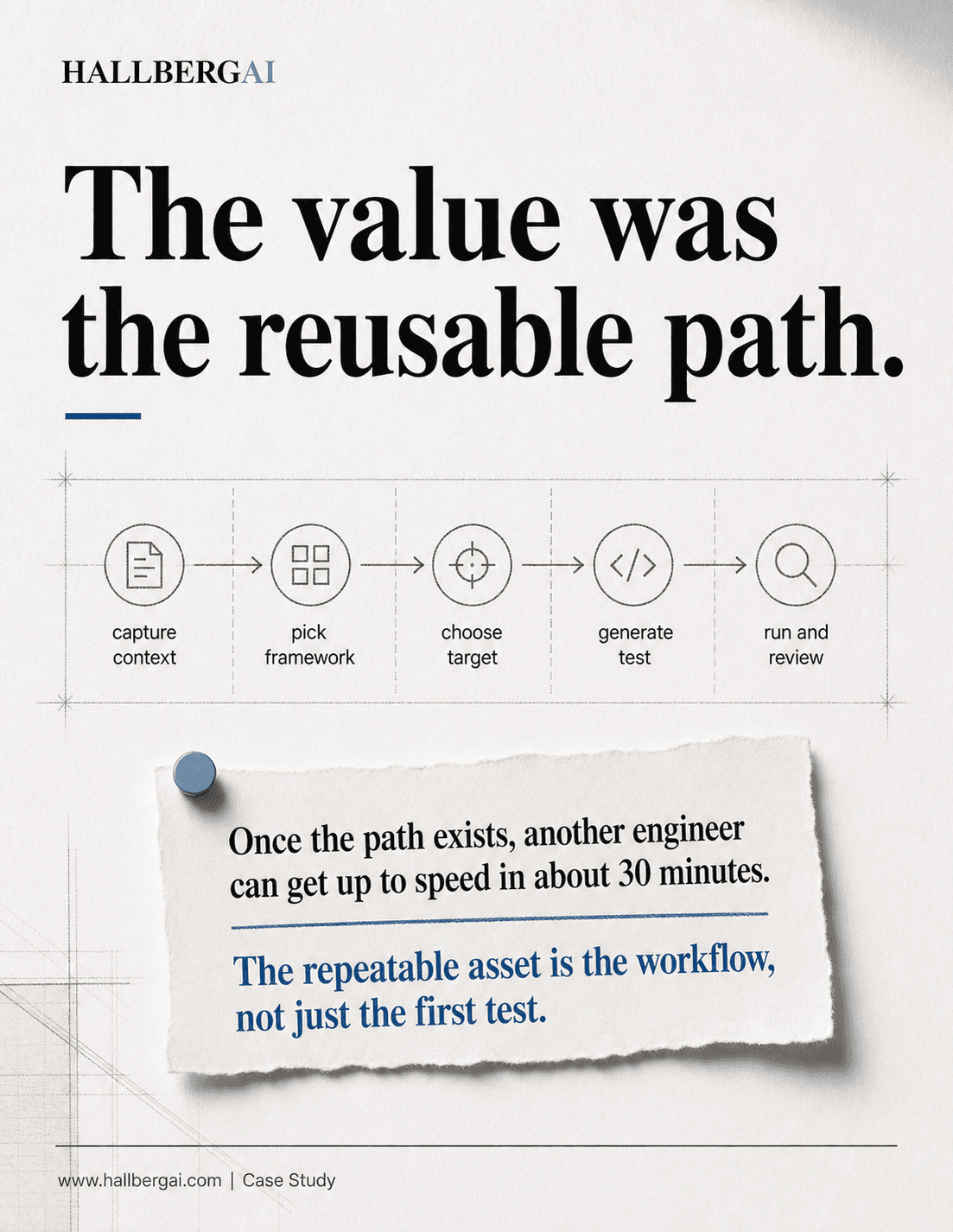
The process became clear enough to repeat: capture context, pick the test framework, choose a target, generate, run, and review before moving on.
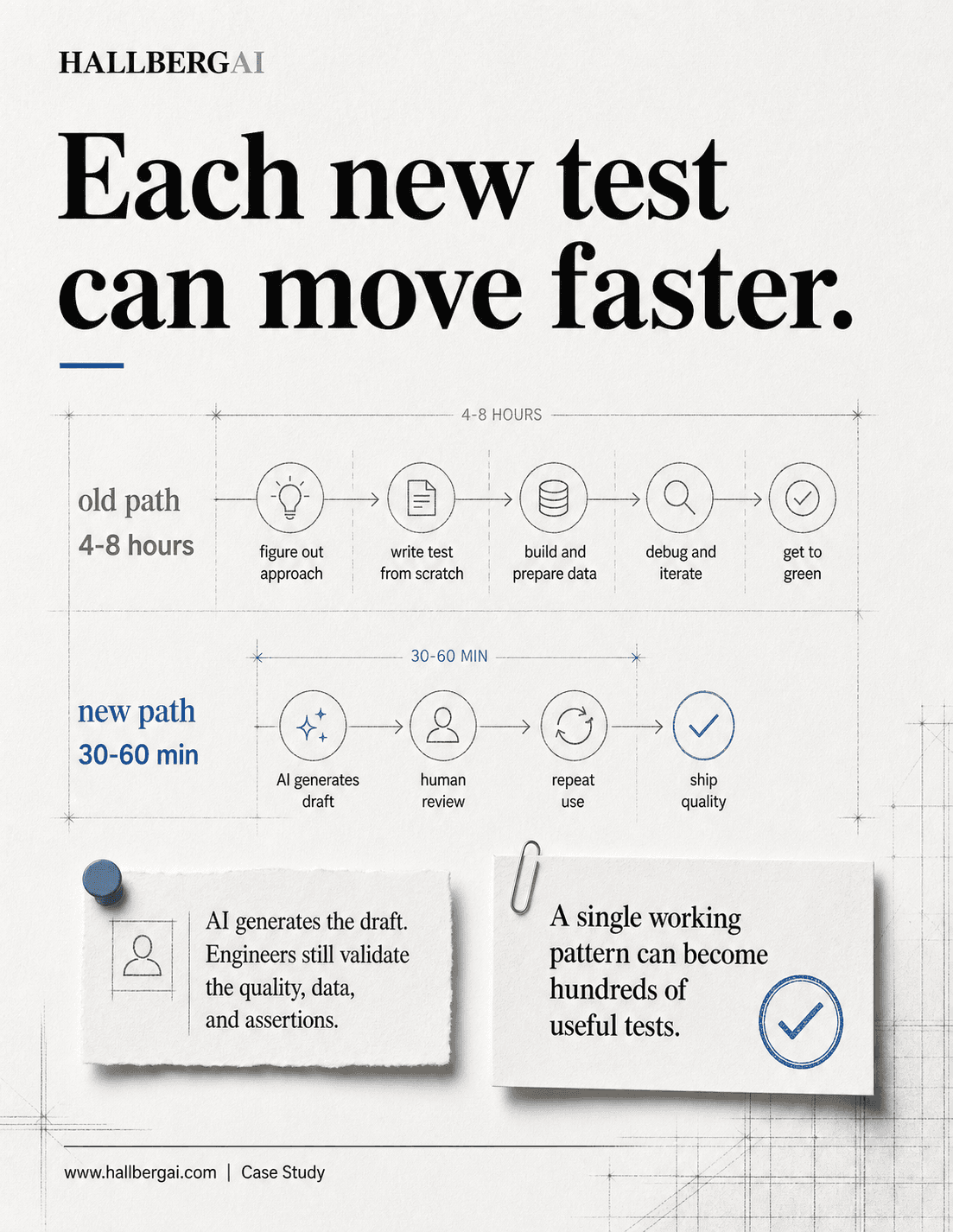
After the setup work was done, new tests could be generated and reviewed in roughly 30-60 minutes instead of several hours of manual discovery.
The process created a handoff path: another engineer could get up to speed in about 30 minutes and keep applying the same approach.
Value
The team avoided an estimated 2-4 weeks of setup and discovery by narrowing the work to one testing workflow and gathering the right context up front. Once the workflow was documented, another engineer could be brought into the process in about 30 minutes.
From there, new tests could be generated and reviewed in roughly 30-60 minutes, compared with a manual path that could take several hours. The workflow gave the team a repeatable way to expand coverage while keeping engineering judgment in the review loop.
Repeatable process
Offer
The goal of the engagement is to help one team turn an AI pilot into a repeatable workflow they can keep using. It starts with one real workflow, not a broad rollout.
Find the first repeatable workflowPhase 1
Identify one workflow where AI can create practical leverage.
Phase 2
Build the context, prompts, review pattern, and governance boundaries.
Phase 3
Run the workflow in real work with the team.
Phase 4
Package the repeatable process so the team can keep using it.
Related resources
Want to find the first repeatable AI workflow inside your engineering team?
Start with one repo, one real workflow, and one measurable behavior change.